Sunday, December 10, 2017

Tuesday, November 14, 2017
Zeus
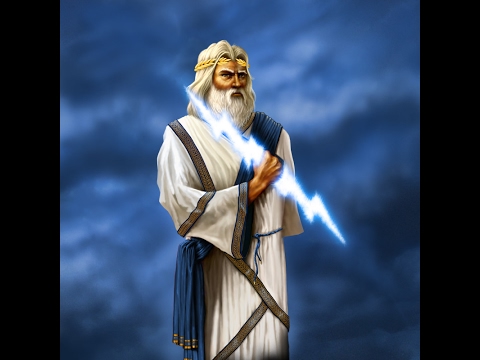
A nearby farmer manages to come up with all the usual dull questions asked by the faithful. For one thing, if there is no Zeus, who brings the rain to water the crops? Inviting the man to use his head for a second, Socrates points out that if Zeus could make it rain, there would or could be rain from cloudless skies. Since this does not happen, it might be wiser to conclude that the clouds are the cause of the rainfall. All right then, says the farmer, who moves the clouds into position? That must surely be Zeus. Not so, says Socrates, who explains about winds and heat. Well in that case, replies the old rustic, where does the lightning come from, to punish liars and other wrongdoers? The lightning, it is gently pointed out to him, does not seem to discriminate between the just and the unjust. Indeed, it has often been noticed to strike the temples of Olympian Zeus himself. This is enough to win the farmer over, though he later recants his impiety and burns down the school with Socrates inside it. Many are the freethinkers who have gone the same way, or escaped very narrowly.
Christopher Hitchens
God Is Not Great... How Religion Poisons Everything
Friday, October 27, 2017
Cha-Ching

To me, one of the biggest tragedies of life would be placing hope, faith, and trust in a philosophy that guaranteed an eternal existence of incredibly great contentment and happiness on the condition that an enormous amount of money is paid and the qualities of empathy, honesty, service, and personal improvement are constantly emulated, and every rule invented by the philosophy remains unbroken. In other words, pay money and act in a manner that all humans are already naturally inclined to act.
To me, an even bigger tragedy of life would be placing hope, faith, and trust in this philosophy then discover that it's promises are bogus and it's only true motivation is to control people and to take their money.
There was a time once in my life when I broke one of the rules of the philosophy I embraced and should have been excommunicated but leniency was extended and I was only disfellowshiped. The other day, I came across the official letter that spelled out the terms of the disciplinary action. Essentially, it stripped me of all privileges like praying in church, singing in the choir, participating in any ordinances like the sacrament, exercising my priesthood like home teaching or giving blessings, and attending the temple. The tone of the letter was constructed in a manner to imply what a travesty it was for me to be denied such wonderful blessings. Interestingly enough, it clarified that I was to continue attending church, reading the scriptures, praying in private for forgiveness, and paying my tithing..!
I have suspected for awhile now that religion in general is only motivated by money. When you consider the amount of money involved (that we are allowed to know about), it becomes hard to ignore how lucrative that form of deception is. It draws us in and numbs our senses to the point that we relinquish complete control of our entire existence into its hands. We endow it as the purest form of goodness and benevolence in our lives while, in fact, it is the biggest deception making it the lowest of all thieves that preys on our greatest vulnerabilities.
I have tried to explain my suspicions to friends and family but they are so deeply caught in the trap and their reasoning has become so deluded that they believe that; even if it's false and costs them a lot of money, their belief makes them happy and causes them to do good and to live fulfilling lives and all of this brings them peace and contentment, so why change?
I wonder how many of them would hang on to a credit card that charged 500% interest based solely on the fact that it provided nice things in their lives and made them happy and content, so why not keep using it?
Monday, October 23, 2017
How the End of Faith Allows for the Beginning of Action
Why I no longer remain active in the
Mormon faith nor maintain a belief in
any religion
(The following quote was penned by Sam Harris (1967 -) in his book entitled, The End of Faith,
Religion, Terror, and the Future of Reason Pp 223-227. It has helped me
realize that belief in dogma is counterproductive and a waste of time. I cannot
deny that, during an earlier period in life, I believed my prayers were being
answered but I now better understand the workings of the human mind. I do not
have all the answers but I trust humanity and I remain optimistically
encouraged by its proven techniques for investigating phenomena, acquiring new
knowledge, and correcting and integrating previous knowledge given that its
inquiry is based on empirical and measurable evidence and subject to specific principles of sound reasoning.) lrg
“My goal… …has been to help close the door to a certain style
of irrationality. While religious faith is the one species of human ignorance
that will not admit of even the possibility
of correction, it is still sheltered from criticism in every corner of our
culture. Forsaking all valid sources of information about this world (both
spiritual and mundane), our religions have seized upon ancient taboos and
pre-scientific fancies as though they held ultimate metaphysical significance.
Books that embrace the narrowest spectrum of political, moral, scientific, and
spiritual understanding—books that, by their antiquity alone, offer us the most
dilute wisdom with respect to the present—are still dogmatically thrust upon us
as the final word on matters of the greatest significance. In the best case,
faith leaves otherwise well-intentioned people incapable of thinking rationally
about many of their deepest concerns; at worst, it is a continuous source of
human violence. Even now, many of us are motivated not by what we know but by
what we are content merely to imagine. Many are still eager to sacrifice
happiness, compassion, and justice in this world, for a fantasy of a world to
come. These and other degradations await us along the well-worn path of piety.
Whatever our religious differences may mean for the next life, they have only
one terminus in this one—a future of ignorance and slaughter.
We live in
societies that are still constrained by religious laws and threatened by
religious violence. What is it about us, and specifically about our discourse
with one another, that keeps these astonishing bits of evil loose in our world?
We have seen that education and wealth are insufficient guarantors of
rationality. Indeed, even in the West, educated men and women still cling to
the blood-soaked heirlooms of a previous age. Mitigating this problem is not
merely a matter of reining in a minority of religious extremists; it is a
matter of finding approaches to ethics and to spiritual experience that make no
appeal to faith, and broadcasting this knowledge to everyone.
Of course,
one senses that the problem is simply hopeless. What could possibly cause
billions of human beings to reconsider their religious beliefs? And yet, it is
obvious that an utter revolution in our thinking could be accomplished in a
single generation: if parents and teachers would merely give honest answers to
the questions of every child. Our doubts about the feasibility of such a
project should be tempered by an understanding of its necessity, for there is
no reason whatsoever to think that we can survive our religious differences
indefinitely.
Imagine what
it would be like for our descendants to experience the fall of civilization.
Imagine failures of reasonableness so total that our largest bombs finally fall
upon our largest cities in defense of our religious differences. What would it
be like for the unlucky survivors of such a holocaust to look back upon the
hurtling career of human stupidity that led them over the precipice? A view
from the end of the world would surely find that the six billion of us
currently alive did much to pave the way to the Apocalypse.
This world
is simply ablaze with bad ideas. There are still places where people are put to
death for imaginary crimes—like blasphemy—and where the totality of a child’s
education consists of his learning to recite from an ancient book of religious
fiction. There are countries where women are denied almost every human liberty,
except the liberty to breed. And yet, these same societies are quickly
acquiring terrifying arsenals of advanced weaponry. If we cannot inspire the
developing world, and the Muslim world in particular, to pursue ends that are
compatible with a global civilization, then a dark future awaits all of us.
The contest
between our religions is zero-sum. Religious violence is still with us because
our religions are intrinsically hostile to one another. Where they appear
otherwise, it is because secular knowledge and secular interests are
restraining the most lethal improprieties of faith. It is time we acknowledged
that no real foundation exists within the canons of Christianity, Islam, Judaism,
or any of our other faiths for religious tolerance and religious diversity.
If religious
war is ever to become unthinkable for us, in the way that slavery and cannibalism
seem poised to, it will be a matter of our having dispensed with the dogma of
faith. If our tribalism is ever to give way to an extended moral identity, our religious
beliefs can no longer be sheltered from the tides of genuine inquiry and
genuine criticism. It is time we realize that to presume knowledge where one
has only pious hope is a species of evil. Wherever conviction grows in inverse
proportion to its justification, we have lost the very basis of human cooperation.
Where we have reasons for what we believe, we have no need of faith; where we
have no reasons, we have lost both our connection to the world and to one
another. People who harbor strong convictions without evidence belong at the
margins of our societies not in our halls of power. The only thing we should
respect in a person’s faith is his desire for a better life in this world; we
need never have respected his certainty that one awaits him in the next.
Nothing is
more sacred than the facts. No one, therefore, should win any points in our
discourse for deluding himself. The litmus test for reasonableness should be
obvious: anyone who wants to know how the world is, whether in physical or
spiritual terms, will be open to new evidence. We should take comfort in the
fact that people tend to conform themselves to this principle whenever they are
obliged to. This will remain a problem for religion. The very hands that prop
up our faith will be the ones to shake it.
It is as yet
undetermined what it means to be human, because every facet of our culture—and
even our biology itself—remains open to innovation and insight. We do not know
what we will be a thousand years from now—or indeed that we will be, given the lethal absurdity of many of our
beliefs—but whatever changes await us, one thing seems unlikely to change: as
long as experience endures, the difference between happiness and suffering will
remain our paramount concern. We will therefore want to understand those
processes--biochemical, behavioral, ethical, political, economic, and
spiritual—that account for this difference. We do not yet have anything like a
final understanding of such processes, but we know enough to rule out many
false understandings. Indeed, we know enough at this moment to say that the God
of Abraham is not only unworthy of the immensity of creation; he is unworthy
even of man.
We do not
know what awaits each of us after death, but we know that we will die. Clearly,
it must be possible to live ethically—without presuming to know things about
which we are patently ignorant. Consider it: every person you have ever met,
every person you will pass in the street today, is going to die. Living long
enough, each will suffer the loss of his friends and family. All are going to
lose everything they love in this world. Why would one want to be anything but
kind to them in the meantime?
We are bound
to one another. The fact that our ethical intuitions must, in some way,
supervene upon our biology does not make ethical truths reducible to biological
ones. We are the final judges of what is good, just as we remain the final
judges of what is logical. And on neither front, has our conversation with one
another reached an end. There need be no scheme of rewards and punishments
transcending this life to justify our moral intuitions or to render them
effective in guiding our behavior in the world. The only angels we need invoke
are those of our better nature: reason, honesty, and love. The only demons we
must fear are those that lurk inside every human mind: ignorance, hatred,
greed, and faith, which is surely the
devil’s masterpiece.
Man is
manifestly not the measure of all
things. This universe is shot through with mystery. The very fact of its being,
and of our own, is a mystery absolute, and the only miracle worthy of the name.
The consciousness that animates us is itself central to this mystery and the
ground for any experience we might wish to call “spiritual.” No myths need be
embraced for us to commune with the profundity of our circumstance. No personal
God need be worshiped for us to live in awe at the beauty and immensity of
creation. No tribal fictions need be rehearsed for us to realize, one fine day,
that we do, in fact, love our neighbors, that our happiness is inextricable
from their own, and that our interdependence demands that people everywhere be
given the opportunity to flourish. The days of our religious identities are
clearly numbered. Whether the days of civilization itself are numbered would
seem to depend, rather too much, on how soon we realize this.”
Thursday, August 10, 2017
I'm A Little Teapot
Bertrand Russell's Parable of the Celestial Teapot
From Richard Dawkins' book "The God Delusion"
Many orthodox people speak as though it were the business of skeptics to disprove received dogmas rather than of dogmatists to prove them. This is, of course, a mistake. If I were to suggest that between the Earth and Mars there is a china teapot revolving about the sun in an elliptical orbit, nobody would be able to disprove my assertion provided I were careful to add that the teapot is too small to be revealed even by our most powerful telescopes. But if I were to go on to say that, since my assertion cannot be disproved, it is intolerable presumption on the part of human reason to doubt it, I should rightly be thought to be talking nonsense. If, however, the existence of such a teapot were affirmed in ancient books, taught as the sacred truth every Sunday, and instilled into the minds of children at school, hesitation to believe in its existence would become a mark of eccentricity and entitle the doubter to the attentions of the psychiatrist in an enlightened age or of the Inquisitor in an earlier time.
Friday, July 21, 2017
Wednesday, May 17, 2017
The Psychological Effects of McDonald's

For a lot of people, McDonald's is enough. They could eat McDonald's all their lives and be completely satisfied.
You've grown up on McDonald's and for a time you enjoyed it. You might even be grateful for it because McDonald's came along and freely gave you burgers and fries when you were starving. But these days you are curious and thoughtful about the quality of the food. You ask if there are any other types of food on the menu? What ingredients really go into the beef patties? What's the nutritional quality of its products? You may have even watched Supersize Me!
You ask to have a meeting with the CEO and you begin to express your doubts. He says, ' You've been watching food documentaries and listening to food podcasts again, haven't you? You need to stop that, and read our menus, watch our commercials, and pray about their truthfulness and you'll find your way back to the light only McDonald's can provide'.
For the entire story, go to Mormon McDonald's An Allegory by Gina Colvin.
Sunday, June 26, 2016
Bullseye

From a response by A. Pratt (slightly edited) regarding an article about the reasons Mormons leave the Church...
This reply to your not-uncommon objections may prove helpful to some.
No scientific and/or historical evidence for the Book of Mormon has yet emerged. That the church and its members urge reliance on faith (“personal evidence,” which is not evidence at all) underscores this point.
Meanwhile, a good deal of evidence has debunked the LDS Church. The trouble is, when an arrow hits, the church moves the target in order to say, “You missed.” A few of the popular target-moving devices employed by the Church with parenthetical examples include:
• “That was policy not doctrine” (among many examples, blacks and the priesthood)
• “He wasn’t speaking as a prophet” and “That was his opinion” (Moves the target when an earlier prophet is later found to have taught false doctrine such as Brigham Young and his Adam/God doctrine)
• “Prophets aren’t perfect” (moves the target from Smith as convicted conman or Young as wrong about blacks and the priesthood to whether they were only human)
• “Don’t judge the church by its members” (moves the target from “by their fruits ye shall know them”)
• “Until I know the answer to that I’ll just have to rely on faith” (moves the target from “the church holds up under scrutiny” to “hang in there even when the church doesn’t hold up”; also moves the target from your own claim that there are “plenty of evidences” [sic])
• “We misinterpreted before, but now we have it right” (DNA and Lamanites)
• “Science has been wrong” (moves the target from a specific claim, such as that DNA shows that Native Americans did not descend from Israelites, to a claim no one made, such as that science has never erred)
• “That’s a lie spread by anti-Mormons” (with today’s easy Internet access, this target has moved to, “Actually, it’s true, but it’s okay because …” See sundry official explanations recently added to lds.org)
• “MY prophet hasn’t said that” (moves the target from what a past prophet said to what a current prophet hasn’t said)
• Each of the five customarily accepted reasons (among Mormons) for someone losing their faith and leaving the Church, namely: 1- being offended, 2- not understanding doctrine, 3- it requires too much effort, 4- anti-Mormon literature, 5- desire to sin. (moves the target from real to assumed objections)
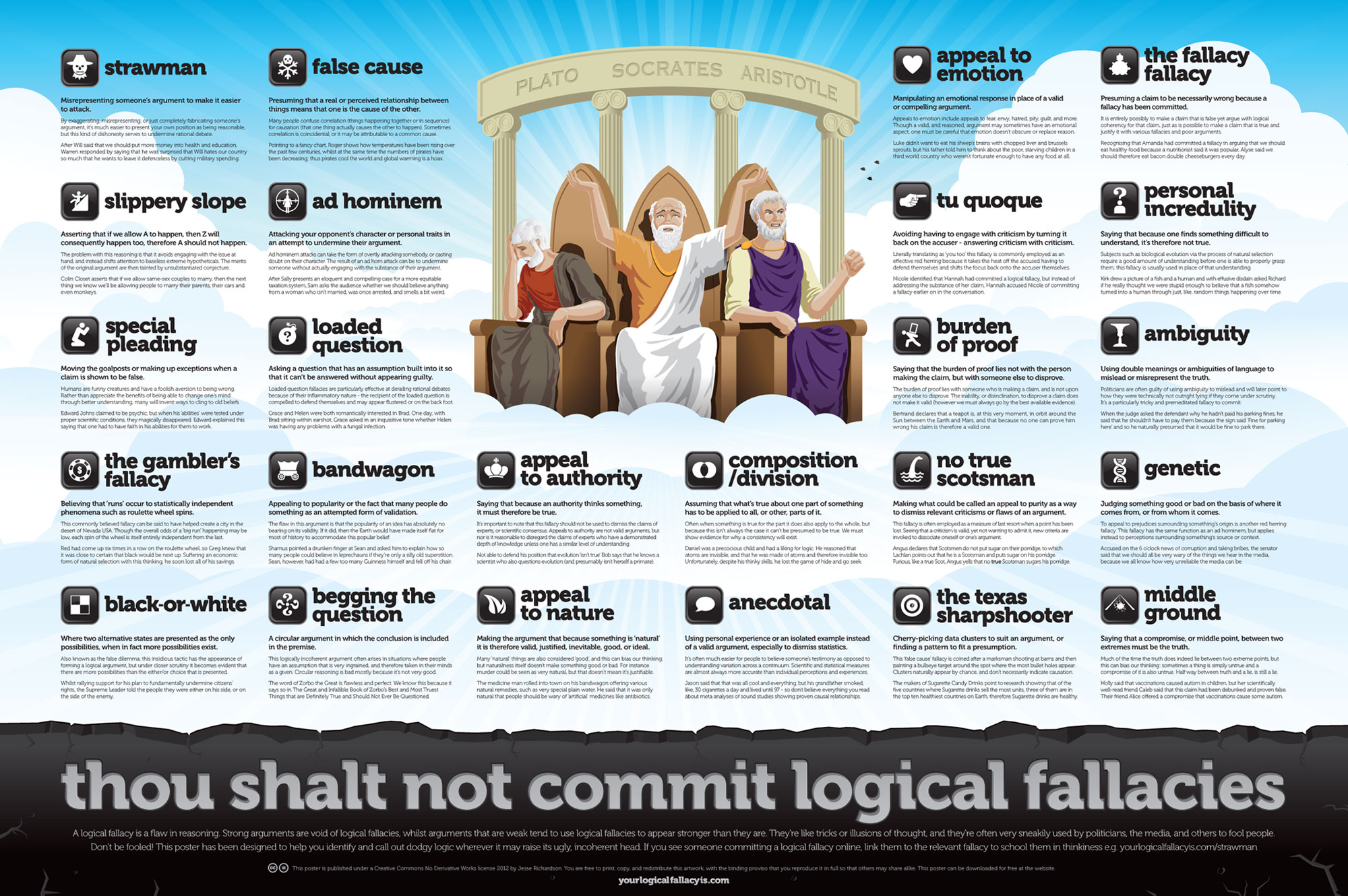
The church and defenders often resort, unwittingly in some cases, to other logical fallacies besides moving the target. Logical fallacies are tricky because they can sound reasonable when in fact they are not. Apologists commonly resort to Special Pleading, Anecdote, Ad Hominem, Straw Man, and Burden of Proof. For a primer on logical fallacies, I recommend https://yourlogicalfallacyis.com/.
“Not disproved” does not equal “proved.” You cannot disprove that my living room sofa communicates telepathically with sea turtles. This hardly means you must accept that it does.
This will most likely be of no use to anyone determined to emerge a believer no matter what. I took the trouble to write it in the hopes that it might be of some use to anyone honestly questioning.
Saturday, April 30, 2016
Naturalism

The cause of lightning was once thought to be God's wrath, but turned out to be the unintelligent outcome of mindless natural forces. We once thought an intelligent being must have arranged and maintained the amazingly ordered motions of the solar system, but now we know it's all the inevitable outcome of mindless natural forces. Disease was once thought to be the mischief of supernatural demons, but now we know that tiny, unintelligent organisms are the cause,which reproduce and infect us according to mindless natural forces. In case after case, without exception, the trend has been to find that purely natural causes underlie any phenomena. Not once has the cause of anything turned out to really be God's wrath, or intelligent meddling, or demonic mischief, or anything supernatural at all. The collective weight of these observations is enormous: supernaturalism has been tested at least a million times and has always lost; naturalism has been tested at least a million times and has always won. A horse that runs a million races and never loses is about to run yet another race with a horse that has lost every single one of the million races it has run. Which horse should we bet on? The answer is obvious.
Richard Carrier
(Click here)

Saturday, February 13, 2016
Friday, February 12, 2016
Skepticism
From the book, "The Demon-Haunted World":
"The tenets of skepticism do not require an advanced degree to master, as most successful used car buyers demonstrate. The whole idea of a democratic application of skepticism is that everyone should have the essential tools to effectively and constructively evaluate claims to knowledge. All science asks is to employ the same levels of skepticism we use in buying a used car or in judging the quality of analgesics or beer from their television commercials.
But the tools of skepticism are generally unavailable to the citizens of our society. They're hardly ever mentioned in the schools, even in the presentation of science, its most ardent practitioner, although skepticism repeatedly sprouts spontaneously out of the disappointments of everyday life. Our politics, economics, advertising, and religions (New Age and Old) are awash in credulity. Those who have something to sell, those who wish to influence public opinion, those in power, a skeptic might suggest, have a vested interest in discouraging skepticism."Have you ever heard the phrase, doubt your doubts? Click here

Wednesday, January 20, 2016
Milk and the Word of Wisdom


How in the world did Joseph Smith miss these terrible details while receiving revelation from God? (See links below.) Maybe God didn't know milk was bad? Or... maybe Joseph Smith didn't know it was bad while making up the revelation to appease his wife. Or... maybe the boys upstairs attending the prophet-school weren't spilling their milk all over the place and spitting it on the floor which then dripped through the floorboards all over Emma's kitchen table downstairs. If that had been the case, what better reason could there be to have included it in the revelation... especially now-a-days considering the recent discoveries about how milk has such an adverse effect on our health. If Smith had included milk in his revelation he might have been laughed at and severely persecuted for it back then, but just think what a hero he would be today.
Based on these discoveries, I think that everybody should write a letter to Pres. Monson and plead for him to petition the Lord for an updated Word of Wisdom revelation that will restrict entrance to the celestial kingdom from those who risk their health by defiling their bodies with milk. The act of being reasonable must be compelled.
Links:
http://health.howstuffworks.com/wellness/food-nutrition/facts/environmental-health-reasons-dairy.htm

Saturday, January 9, 2016
On Religion and Miracles
I truly want to believe that there is a God and that religion
might be on to something. But until religion is able to subdue its overwhelming
lust for power, control, and wealth (since that is where religion
hypocritically teaches God is not found), I don't think it will ever be able to
demonstrate who God is.
The following is an excerpt from Carl Sagan's book, The Varieties of
Scientific Experience, A personal View of
the Search for God. (New York : Penguin Group US, 2006)
Without a doubt it is
more interesting if miracles occur than if they do not. It makes a better
story. And I can recall a case that happened to me. I was at a restaurant
nearby Harvard University. Suddenly the proprietor and most of the diners
rushed outside, napkins still trucked under their belts. My attention was
attracted. I rushed outside also and saw a very strange light in the sky. I
lived not far away, walked home... got a pair of binoculars, came back and with
the binoculars was able to see that the one light was actually divided into two
lights, that exterior to the two lights were a red light and a green light. The
red light and the green light were blinking, and it was, it later turned out, a
massive weather airplane with two powerful searchlights to determine the
turbidity of the atmosphere. I told the people at the restaurant what I had
seen. Everyone was uniformly disappointed. I asked why. And everyone had the
same answer. It is a memorable story to go home and say, "I just saw a
spaceship from another planet hovering over Harvard Square." It is a
highly non-memorable story to go home and say, "I saw an airplane with a
bright light."
But beyond that, miracles speak to us of all sorts of things
religious that we have powerful wishes to believe. This is true to such an
extent that people become very angry when miracles are debunked. One of the
most interesting cases of this sort - and there are thousands of them - is
within the Roman Catholic Church where there is an established procedure for
verifying alleged miracles. It is, in fact, where the phrase "devil's
advocate" comes from. The devil's advocate is the person who proposes
alternative explanations of the alleged miracle, to see how good the evidence
is. I have in front of me a newspaper clipping from June, 1983 (click
here) titled "Priests Denounced After Rejecting Miracle Claim."
And let me just read a few sentences:
Stockton, California... Angry believers
denounced a panel of priests as "a bunch of devils" after the
clergymen ruled that a weeping Madonna in a rural Roman Catholic Church is
probably a hoax, not a miracle. One woman, Lavergne Pita, burst into tears when
the findings were announced Wednesday by the Diocese of Stockton. Manuel Pita
protested that "these investigators are not investigators. They're a bunch
of devils. How can they do this?" Reports that the sixty-pound statue
sheds real tears and can move as far as thirty feet from its niche in Mater Ecclesiae
Mission Church in Thornton California began circulating two years ago. Church
attendance has tripled since then. ... Last year, the Diocese named a
commission to study the reports. In announcing the panel's finding, Bishop
Roger M. Mahoney said the events connected with the statue "do not meet
the criteria for an authenticated appearance of Mary, the mother of Jesus
Christ." The statue may have been moved, the tears may have been applied.
... Actually, the tears were never reported to flow, they were just seen, and
they were gluey. One of the proponents said, "When the virgin appeared to
the kids in Portugal, they didn't believe them either. These things usually
happen to the humble and low incomes, the poor," he added.
Well, I would like now to tell you about one of the most
extraordinary studies on this subject that I know of, which is one of the few
cases where not just supposed miraculous events occurred but where they were
studied in great detail by a team of observers, who infiltrated the religious
group in order to do sociological research. They convinced the group that they
were there because they were also believers. This is an extremely interesting
case, because the prophecies, every one of them, failed utterly. And those are
not the cases we tend to hear about.
The story comes from a book called, When Prophecy Fails, by
Leon Festinger et al. (For
more information, click here.) It was published in the middle 1960's and
refers to events that occurred in Minneapolis, Minnesota, in the 1950's. A
woman in Minneapolis believed that she was receiving a message by automatic
writing. Do you know what automatic writing is? It happens to people all over
the world. It's where the hand with the pen or pencil in it seemingly takes on
a life of its own and writes things when, as far as anyone else can see, the
person who belongs to the hand is asleep or doing something else. There seems
little doubt that the person who is attached to the hand is responsible for
what is happening on the paper. But it has an eerie sense of happening not just
unconsciously but from some external source. In this case, the automatic
writing was from Jesus -- or at least a modem incarnation of him -- who was
resident on an otherwise undiscovered planet called Clarion. The message was
urgent. It said that a flood would inundate the Earth (despite the biblical
promise made to Noah), on the twenty-first of December, would cover most of the
United States and the Soviet Union, among other nations, and would raise the
lost continents of Atlantis and Mu. Spacemen from the planet Clarion would
arrive before the flood to rescue the faithful, take them up on the flying saucers,
and bring them to Clarion.
The group that formed around the woman who did the automatic
writing were ordinary people, in no sense obviously deranged. One of the
leaders of the group was a physician who was examined by psychiatrists, I guess
on the grounds that it was extraordinary for a physician to believe this but
for anyone else it was expected. He was adjudged to be entirely sane although
"holding unusual ideas." The group received numerous messages -- six
or eight -- advising them to be present at a certain time in a certain place to
be picked up by flying saucers before the event, and, as will be no surprise to
you, the Clarionites never appeared. If they had appeared, you would have heard
of it before now. The flood itself also never appeared, although earthquakes in
several parts of the world occurred within a day of the predicted inundation,
and that was taken by the enthusiasts in the group to be partial confirmation
of the flood.
As you can imagine, the failure of the flood on December 21
produced some consternation in the group but by no means led to the group
falling apart. They responded wholeheartedly to a subsequent automatic-writing
message that they were to sing Christmas carols in the cold outside the house
of one of their leaders, preparatory to still another UFO pickup, which they
did, surrounded by a crowd of some two hundred taunting onlookers and police to
separate them from the onlookers. They showed great dedication, great courage.
But a skeptical approach to the world, they cannot be said to have exhibited.
Now, as to their understanding of how it is that they were
not picked up, there were several sets of explanations, and I'll just list
them: They had misunderstood the message (although it said in plain English
what they were to do and it was signed "Jesus" or "God
Almighty"). Another explanation was that they had been insufficiently
dedicated, that their faith had not been strong enough. Or that all this was
merely a test by the extraterrestrials to see how committed they were and that
the extraterrestrials never intended to flood the Earth, just to test their
faith. Or that the predictions were entirely valid but they got the date wrong.
It would happen ten thousand years later... a small mistake. Or that the
inundation would have happened but the coterie of the faithful sufficiently
impressed God with their faith that God intervened on behalf of mankind, and
we're all alive because these people had believed strongly enough.
All these explanations are not mutually consistent, but they
show a remarkable inventiveness and a striking unwillingness to change a set of
beliefs in the face of contradictory evidence. Eventually most of the adherents
drifted away from the movement, but even those who left first had repeatedly
shown heroic fidelity in the face of what they call
"disconfirmation," to say nothing of external skepticism. It's clear
that mutual support within the belief system was central to the success,
however short-lived, of the faith.
There was no charismatic leader here. No ambitious
scoundrel. It was automatic writing and ordinary people. Indeed, the group cast
about looking for guidance. They thought that spacemen from Clarion must be
around them in the most unlikely contexts. For example, there were a bunch of
leather-jacketed, motorcycle-riding young men who had come to scoff, whom they
immediately took to be the angels from Clarion. And likewise the members of the
social-science research team, who had infiltrated the movement trying to
understand how religious movements get started, were also taken as angels from
Clarion. This posed all sorts of challenges to the proper detachment of
scientist from subject.
Most of these people had previously been involved in other borderline
religions or pseudoscientific groups, including UFO clubs, spiritualists,
Dianetics, which has since transmogrified into something called Scientology,
and so on. But it is the very ordinariness of this group that I believe gives
some real insights into the origins of religion. Let me Quote the concluding sentences
by Festinger et al.:
They were unskilled proselytizers.
It is interesting to speculate, however, on what they might have made of their
opportunities had they been more effective apostles. For about a week they were
headline news throughout the nation. Their ideas were not without popular
appeal and they received hundreds of visitors, telephone calls and letters from
seriously interested citizens as well as offers of money which they invariably
refused. Events conspired to offer them a truly magnificent opportunity to grow
in numbers. Had they been more effective, disconfirmation might have portended
the beginning and not the end.
Suppose they'd had a charismatic leader. Or suppose that by
chance there had been a spectacular UFO sighting at the time of the predicted
inundation, for example, an Air Force test of a new kind of aircraft. Or
suppose that the message that came from Clarion was not just that there was
going to be a flood but something powerful, something moving, something that spoke
to an oppressed minority in the United states or elsewhere. Then I think we can
see the possibility that the Clarion religion would have grown into something
much larger. If we look at recent religions - and let me restrict myself to
those that have more than a million adherents - we find, for example, one that
confidently predicted that the world would end in 1914. Unambiguous. And when
the world did not end in 1914 (as far as one can tell it has not), they did not
argue that, oh, they made a small mistake in arithmetic, it was actually 2014,
hope no one was inconvenienced. They did not say that, well, the world would have ended, but they were
sufficiently faithful that God intervened. No. They said, and it is still the
major tenet of their faith, that the world did
end in 1914 and we simply haven't noticed yet. This is a religion with millions
of adherents, currently in the United States. (Click
here)
Or there is a religion that says that all diseases are
psychogenic, that there is no such thing as a microorganism producing disease.
There is no such thing as a cellular malfunction producing a disease, that the
only thing that produces disease is not thinking right, not having adequate faith.
And I need not remind you that there is a significant body of medical evidence
to the contrary. (Click
here)
There is a religion that believes that in the nineteenth
century a set of golden tablets was prepared by an angel and dug up by a
divinely inspired human being. And the tablets were written in an unknown
language of Reformed Egyptian hieroglyphics and had on them a hitherto-unknown
set of books like those in the Old Testament. And, unfortunately, the angel
took them back and the tablets are not available for any scrutiny these days. In
addition, there is powerful evidence of conscious fraud at the time that the
religion was founded, which led, last week, to two people being killed in the
state of Utah, having to do with some early letters from the founders of the
religion that were inconsistent with doctrine. (Click here)
Or there is a religion that believes that if you only have
enough faith, you can levitate. I mean, that you can bodily float off the
ground and propel yourself. It has many practical applications, if only it were
true. (Click
here) These are perfectly typical tenets or aspects of modern religions.
And if that is true, what about ancient religions? After
all, there is a much greater distance in time between us and those earlier
religions. And that means that there are much larger opportunities for fraud
and for changing the disquieting details. I remind you that rewriting history is
done all the time. To give an example - there are so many - one of the leaders
of the Russian Revolution was a man named Lev Davidovich Bronstein, also known
as Leon Trotsky. He founded the Red Army, he established the modern Soviet
railroad system, he was the founder and first editor of Pravda, he played a
leading role in both the 1905 and the 1917 revolutions, but he does not exist
in the Soviet Union. He's not there. You cannot find anything about him. There
is no picture of him. In a two-volume Soviet history of the world, he appears
once, as having inappropriate agricultural views. Otherwise unmentioned. They
have simply written him out of the history of their own revolution, in which he
played an absolutely central role, second perhaps only to that of Lenin. So now
imagine that a religion is founded not just a few decades ago but a few
centuries or a few thousand years ago, in which the received wisdom passes
through a small group--a small priesthood. Think of the opportunities for
changing disquieting facts in the interim. David Hume says,
"The many instances of forged
miracles and prophecies and supernatural events, which in all ages have either
been detected by contrary evidence or which detect themselves by their
absurdity, prove sufficiently the strong propensity of mankind to the
extraordinary and marvelous and ought reasonably to beget a suspicion against
all relations of this kind. It is strange, a judicious reader is apt to say,
that such prodigious events never happen in our day, but it is nothing strange
that men should lie in all ages."
And then on the point that I was just making, he says,
"In the infancy of new
religions the wise and learned commonly esteem the matter too inconsiderable to
deserve their attention or regard. And then when afterwards they would
willingly detect the cheat in order to undeceive the deluded multitudes, the
season is now past and the records and witnesses which might clear up the
matter have perished beyond recovery."
Well, it seems to me that there is only one conceivable
approach to these matters. If we have such an emotional stake in the answers,
if we want badly to believe, and if it is important to know the truth, then
nothing other than a committed, skeptical scrutiny is required. It is not very
different from buying a used car. When you buy a used car, it is insufficient
to remember that you badly need a car. After all, it has to work. It is
insufficient to say that the used-car salesman is a friendly fellow. What you
generally do is you kick the tires, you look at the odometer, you open up the
hood. If you do not feel yourself expert in automobile engines, you bring a
friend who is. And you do this for something as unimportant as an automobile.
But on issues of the transcendent, of ethics and morals, of the origin of the
world, of the nature of human beings, on those issues should we not insist upon
at least equally skeptical scrutiny?
Friday, December 11, 2015
Upon This Rock

Throughout the early years of my lifetime, the Mormon Church vigorously denied any story that even suggested that Joseph Smith was ever involved in necromancy, witchcraft, or peep-stone money digging. They were called anti-Mormon lies. They regularly excommunicated any member who dared to publish any researched endorsement of the "lie". Today, in view of the Church's admission that those stories were true, it literally creates pain in my heart each time I think about the Church's historical pathway strewn with the bodies of intelligent and well-meaning members who were shunned and cast out for only trying to tell it like it is. Honesty: a virtue taught, no, demanded by a church who will oust you when you try to tell the truth.

Hasn't religion progressed nicely though? At least we aren't murdering people like we used to who dared to endorse the witch's notion that the sun was stationary or the earth was round. Our brutal, medieval barbarianism in modern times is so much more humane. Now-a-days the popular thing to do is to just destroy them psychologically. Then when we finally are forced to admit that they were right, because this a God's work, no apologies are needed... apparently.
I remember an incident in High School with a classmate, David McBride. We sat next to each other in the band's trombone section and became friends. He knew I was Mormon and we occasionally compared religious notes. We had a discussion once that eventually became heated (in a friendly way) when he accused Joseph Smith of putting a rock in his hat to translate the golden plates. Having never heard of that one before, I was absolutely blown away that anyone could accept such a ridiculous supposition as being true. I argued that the claim's own absurdity should certainly confirm the obvious fallacy of such a laughable allegation. I told him that if what he was saying was true, I would leave the Church tomorrow and never look back.

I'm embarrassed to admit it now but I even spun it around and used it to my advantage by preaching a short sermon of chastisement. I pulled out my persecution card and told him how much damage it causes when gullible people fall for anti-Mormon lies then spread them around without documented facts. He was a bit embarrassed and admitted that he didn't know much about it because it was just something he had heard. He asked me to clarify how the translation process was accomplished. I recall being relieved when Mr. Larson, the band director, shushed us so I never got the chance to answer. I'm sure that David would have called me out on the absurdity of the other story I would have had to tell.
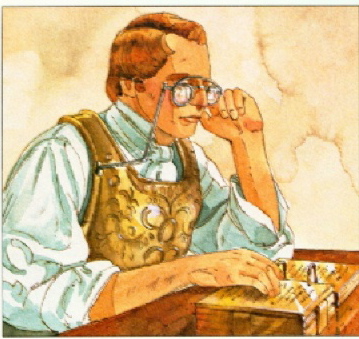
David McBride... If you're reading this, I apologize. You were right. I was wrong. He DID translate the plates with a rock in his hat. (Click Here) However, I WAS right regarding the absurdity of that story.
Tuesday, November 10, 2015
Saturday, November 7, 2015
This Is Really, Really Bad News For the Church
Recently, Mormon Church leaders once again officially confirmed that God discriminates. They now hold children responsible for the sins of their parents.


Tuesday, October 13, 2015
Truth and Lies

Let's imagine you are 1000 feet in the air, standing on the high steel framework of a new skyscraper under construction. You are supported by each of the steel girders below you, and the massive concrete foundation is resting on the bedrock of the Earth. Your primary interest at this point is your safety. The girders below must each be riveted well to one another; because if even ONE is just jammed in with no rivets, the whole structure could fall at any moment! Any girder with no rivets is like a lie, because you put your trust in it as if it were the truth. The only way to know if each girder is "true" is to closely examine each one. To appear to be a part of the structure is not enough in itself, because you place your trust in every girder below you believing they are "true". If you are on a framework built up on 100% TRUTH, then you are safe. If you can be shown the "girders" that have no rivets, exposing the deceptions as the lies they really are, then you would be wise to re-evaluate the wisdom of remaining where you are.

Thursday, August 13, 2015

Sunday, July 26, 2015
Testimony
In the comments section of a popular blog, a poster named Rude Dog poked fun at the term "testimony" because we use it as if it were a legitimate term... a term of knowing.
"Using the term... outside the Mormon and Born Again Christian paradigm leaves most with a perplexed expression. Perhaps you should go as far as to contact the various national academies and recommend that their methods of epistemology are archaic, and that the 'burning bosom' method of knowledge acquisition should be employed. When comes the day when one grows up and leaves a bawling immaturity that defines the infancy of our species will we realize that when it comes to the metaphysical, the supernatural, there is nothing that one can 'know', but only what can be believed or not believed. I get it that one can believe, but don't project upon the true reality that somehow God has spoken to you but not to me, for greater hubris and solipsism there is none. I don't think the religious realize how 'proud' they really are."
"Using the term... outside the Mormon and Born Again Christian paradigm leaves most with a perplexed expression. Perhaps you should go as far as to contact the various national academies and recommend that their methods of epistemology are archaic, and that the 'burning bosom' method of knowledge acquisition should be employed. When comes the day when one grows up and leaves a bawling immaturity that defines the infancy of our species will we realize that when it comes to the metaphysical, the supernatural, there is nothing that one can 'know', but only what can be believed or not believed. I get it that one can believe, but don't project upon the true reality that somehow God has spoken to you but not to me, for greater hubris and solipsism there is none. I don't think the religious realize how 'proud' they really are."
"For the Blessing of the Lamanites"
Relief Society Magazine, August 1964
For the entire article, click here.
"In fulfillment of Nephi's prophetic words, the Lamanites in our day are, indeed, being restored to their rightful place in the House of Israel. By their obedience to the principles of the gospel, they are beginning to receive the blessings promised to their ancient fathers.
Today thousands of Lamanites are coming into the Church. More than one hundred Lamanite branches have been organized among the stakes and within the missions. In many of these branches, the leadership is provided by the Lamanite menbers. They are the branch presidents, the teachers, the auxiliary leaders, the music directors. Lives are being transformed, In some cases, whole Indian communities are being affected.
Every Latter-day Saint should be a friend and a champion of the Indian people. We must be certain that blessings are not withheld because of any indifference or intolerance on our part. Our patient labor in behalf of Lehi's seed can help them to reclaim their inheritance in this land."
(Boyd K. Packer)
As I understand it, (correct me if I'm wrong) although Boyd Packer never served as the prophet, seer, and revelator (president of the Church), as an apostle he was considered to be a prophet. I presume then that it is safe to assume that all of the apostles are prophets. I did a quick count and according to the internet, there have been more than 100 apostles since the 1830 organization of the church and every one of them (with the exception of perhaps some of the current apostles) have endorsed the Book of Mormon premise that the American Indians all descended from Laman through Lehi who was an Israelite. Historically, the archives are ripe with testimonials from hundreds of general authorities that the Book of Mormon is a chronicle of the Indian's origins and was written for their benefit.
In the last recent years, Science and its advancements in the field of DNA studies has concluded that this is not the case saying that the vast majority of Indians on this continent migrated here from Asia. There is no connection between them and Lehi, Laman, or Israel. This fact is well enough established and of such high credibility that even the Church has re-written the introduction to the Book of Mormon in an attempt to lighten or obfuscate the directness of the book's and Joseph Smith's claim.
My question is this. Of the more than 100 prophets who supposedly communicate with God and Jesus Christ and have direct access to insight and inspiration, why didn't God tell at least one of them, over the course of the last 150 years or so, to correct the mistaken concept so that the change came from Him and not from science? Why did He hang His prophets out to dry and leave them to suffer the embarrassment of science proving them to be wrong and forcing them to make corrections?
For me, this is huge. It's a deal-breaker. This is not a doubt that I can doubt. This is fact. I saw this happen with my own eyes in my own lifetime. My integrity will not allow me to overlook it or deny to myself that it happened. Based on this one fact, how can I possibly expect myself to believe that the Book of Mormon is true?
For the entire article, click here.
"In fulfillment of Nephi's prophetic words, the Lamanites in our day are, indeed, being restored to their rightful place in the House of Israel. By their obedience to the principles of the gospel, they are beginning to receive the blessings promised to their ancient fathers.
Today thousands of Lamanites are coming into the Church. More than one hundred Lamanite branches have been organized among the stakes and within the missions. In many of these branches, the leadership is provided by the Lamanite menbers. They are the branch presidents, the teachers, the auxiliary leaders, the music directors. Lives are being transformed, In some cases, whole Indian communities are being affected.
Every Latter-day Saint should be a friend and a champion of the Indian people. We must be certain that blessings are not withheld because of any indifference or intolerance on our part. Our patient labor in behalf of Lehi's seed can help them to reclaim their inheritance in this land."
(Boyd K. Packer)
As I understand it, (correct me if I'm wrong) although Boyd Packer never served as the prophet, seer, and revelator (president of the Church), as an apostle he was considered to be a prophet. I presume then that it is safe to assume that all of the apostles are prophets. I did a quick count and according to the internet, there have been more than 100 apostles since the 1830 organization of the church and every one of them (with the exception of perhaps some of the current apostles) have endorsed the Book of Mormon premise that the American Indians all descended from Laman through Lehi who was an Israelite. Historically, the archives are ripe with testimonials from hundreds of general authorities that the Book of Mormon is a chronicle of the Indian's origins and was written for their benefit.
In the last recent years, Science and its advancements in the field of DNA studies has concluded that this is not the case saying that the vast majority of Indians on this continent migrated here from Asia. There is no connection between them and Lehi, Laman, or Israel. This fact is well enough established and of such high credibility that even the Church has re-written the introduction to the Book of Mormon in an attempt to lighten or obfuscate the directness of the book's and Joseph Smith's claim.
My question is this. Of the more than 100 prophets who supposedly communicate with God and Jesus Christ and have direct access to insight and inspiration, why didn't God tell at least one of them, over the course of the last 150 years or so, to correct the mistaken concept so that the change came from Him and not from science? Why did He hang His prophets out to dry and leave them to suffer the embarrassment of science proving them to be wrong and forcing them to make corrections?
For me, this is huge. It's a deal-breaker. This is not a doubt that I can doubt. This is fact. I saw this happen with my own eyes in my own lifetime. My integrity will not allow me to overlook it or deny to myself that it happened. Based on this one fact, how can I possibly expect myself to believe that the Book of Mormon is true?
Subscribe to:
Posts (Atom)