Favorite Quotes

Introduction

To bring you up to date… an enlightening chronicle that briefly takes you through the birth of a dream, around the enduring course of difficulties, obstacles, and distractions, then the sprint to the elusive finish line, which is always further away than it seems... but can't be far off now!

I have tried to keep these postings in a chronological sequence so, for first time visitors, go to the bottom of "What I've been doing" where you'll find the first entry and the most recent entry will be at the top.

I have recently felt the need to add a disclaimer. The tone of this blog tends to follow after the mood and interests of the editor. While its original intent was to chronicle my boating escapades, of recent, my adventures have begun to embrace a religious flavor. For this reason, I'd like to clarify that, although the posts may appear biased, I advise you to reject any notion suggesting that I, in fact, may appear to be endorsing any predilection or point of view. Anymore, I believe what I believe, which is between myself and I, and I have learned that beliefs are personal and deserve being protected from public scrutiny. Please view anything posted within this site only as food for thought.


Thursday, August 10, 2017

I'm A Little Teapot


Bertrand Russell's Parable of the Celestial Teapot
From Richard Dawkins' book "The God Delusion"

Many orthodox people speak as though it were the business of skeptics to disprove received dogmas rather than of dogmatists to prove them. This is, of course, a mistake. If I were to suggest that between the Earth and Mars there is a china teapot revolving about the sun in an elliptical orbit, nobody would be able to disprove my assertion provided I were careful to add that the teapot is too small to be revealed even by our most powerful telescopes. But if I were to go on to say that, since my assertion cannot be disproved, it is intolerable presumption on the part of human reason to doubt it, I should rightly be thought to be talking nonsense. If, however, the existence of such a teapot were affirmed in ancient books, taught as the sacred truth every Sunday, and instilled into the minds of children at school, hesitation to believe in its existence would become a mark of eccentricity and entitle the doubter to the attentions of the psychiatrist in an enlightened age or of the Inquisitor in an earlier time.


Wednesday, May 17, 2017

The Psychological Effects of McDonald's


For a lot of people, McDonald's is enough. They could eat McDonald's all their lives and be completely satisfied.

You've grown up on McDonald's and for a time you enjoyed it. You might even be grateful for it because McDonald's came along and freely gave you burgers and fries when you were starving. But these days you are curious and thoughtful about the quality of the food. You ask if there are any other types of food on the menu? What ingredients really go into the beef patties? What's the nutritional quality of its products? You may have even watched Supersize Me!

You ask to have a meeting with the CEO and you begin to express your doubts. He says, ' You've been watching food documentaries and listening to food podcasts again, haven't you? You need to stop that, and read our menus, watch our commercials, and pray about their truthfulness and you'll find your way back to the light only McDonald's can provide'.

For the entire story, go to Mormon McDonald's An Allegory  by Gina Colvin.


Sunday, June 26, 2016

Bullseye


From a response by A. Pratt (slightly edited) regarding an article about the reasons Mormons leave the Church...


This reply to your not-uncommon objections may prove helpful to some.
No scientific and/or historical evidence for the Book of Mormon has yet emerged. That the church and its members urge reliance on faith (“personal evidence,” which is not evidence at all) underscores this point.
Meanwhile, a good deal of evidence has debunked the LDS Church. The trouble is, when an arrow hits, the church moves the target in order to say, “You missed.” A few of the popular target-moving devices employed by the Church with parenthetical examples include:
• “That was policy not doctrine” (among many examples, blacks and the priesthood)
• “He wasn’t speaking as a prophet” and “That was his opinion” (Moves the target when an earlier prophet is later found to have taught false doctrine such as Brigham Young and his Adam/God doctrine)
• “Prophets aren’t perfect” (moves the target from Smith as convicted conman or Young as wrong about blacks and the priesthood to whether they were only human)
• “Don’t judge the church by its members” (moves the target from “by their fruits ye shall know them”)
• “Until I know the answer to that I’ll just have to rely on faith” (moves the target from “the church holds up under scrutiny” to “hang in there even when the church doesn’t hold up”; also moves the target from your own claim that there are “plenty of evidences” [sic])
• “We misinterpreted before, but now we have it right” (DNA and Lamanites)
• “Science has been wrong” (moves the target from a specific claim, such as that DNA shows that Native Americans did not descend from Israelites, to a claim no one made, such as that science has never erred)
• “That’s a lie spread by anti-Mormons” (with today’s easy Internet access, this target has moved to, “Actually, it’s true, but it’s okay because …” See sundry official explanations recently added to lds.org)
• “MY prophet hasn’t said that” (moves the target from what a past prophet said to what a current prophet hasn’t said)
• Each of the five customarily accepted reasons (among Mormons) for someone losing their faith and leaving the Church, namely: 1- being offended, 2- not understanding doctrine, 3- it requires too much effort, 4- anti-Mormon literature, 5- desire to sin. (moves the target from real to assumed objections)
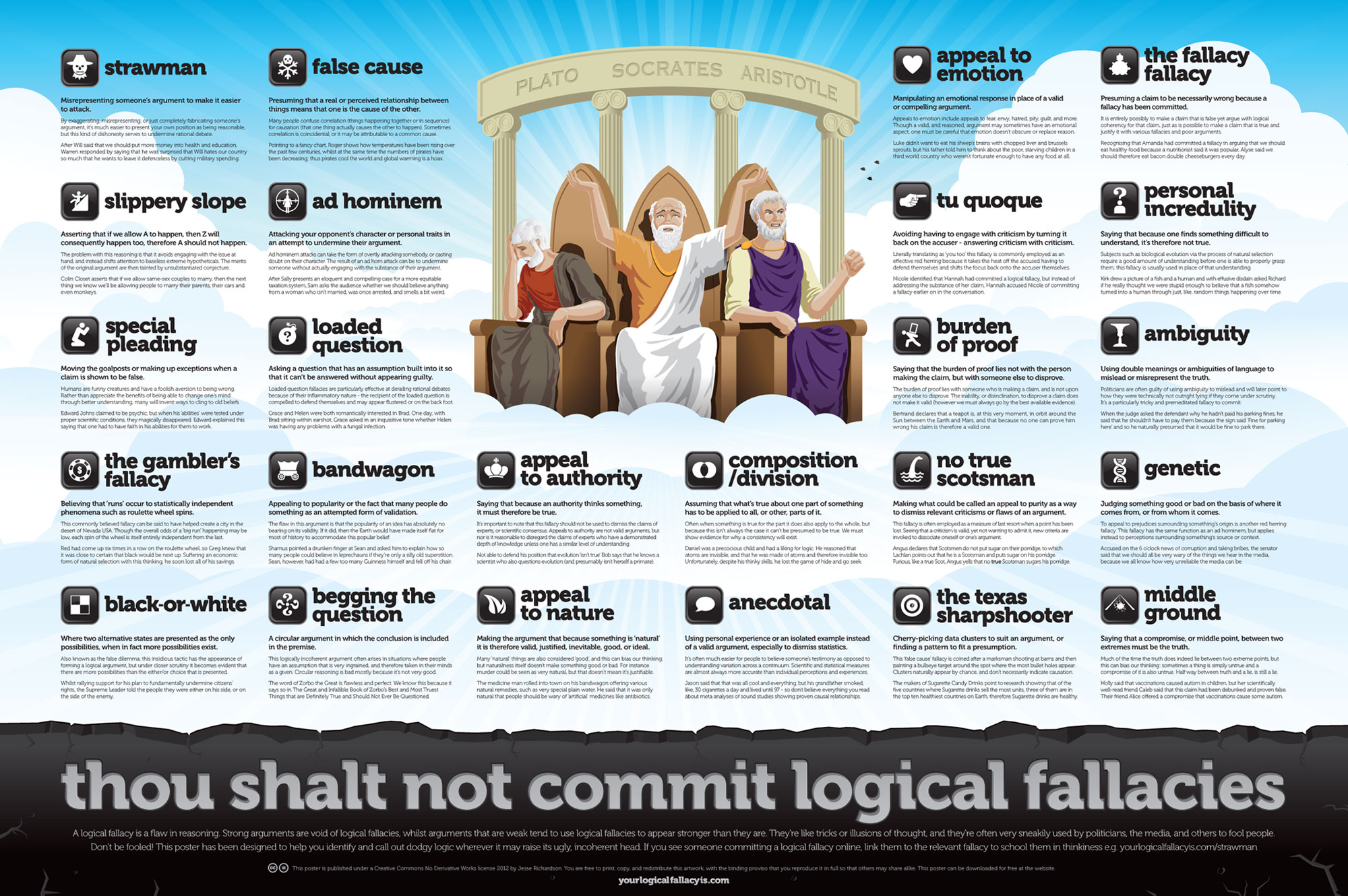
The church and defenders often resort, unwittingly in some cases, to other logical fallacies besides moving the target. Logical fallacies are tricky because they can sound reasonable when in fact they are not. Apologists commonly resort to Special Pleading, Anecdote, Ad Hominem, Straw Man, and Burden of Proof. For a primer on logical fallacies, I recommend https://yourlogicalfallacyis.com/.
“Not disproved” does not equal “proved.” You cannot disprove that my living room sofa communicates telepathically with sea turtles. This hardly means you must accept that it does.

This will most likely be of no use to anyone determined to emerge a believer no matter what. I took the trouble to write it in the hopes that it might be of some use to anyone honestly questioning.


Saturday, April 30, 2016

Naturalism


The cause of lightning was once thought to be God's wrath, but turned out to be the unintelligent outcome of mindless natural forces. We once thought an intelligent being must have arranged and maintained the amazingly ordered motions of the solar system, but now we know it's all the inevitable outcome of mindless natural forces. Disease was once thought to be the mischief of supernatural demons, but now we know that tiny, unintelligent organisms are the cause,which reproduce and infect us according to mindless natural forces. In case after case, without exception, the trend has been to find that purely natural causes underlie any phenomena. Not once has the cause of anything turned out to really be God's wrath, or intelligent meddling, or demonic mischief, or anything supernatural at all. The collective weight of these observations is enormous: supernaturalism has been tested at least a million times and has always lost; naturalism has been tested at least a million times and has always won. A horse that runs a million races and never loses is about to run yet another race with a horse that has lost every single one of the million races it has run. Which horse should we bet on? The answer is obvious.

Richard Carrier
(Click here)


Friday, February 12, 2016

Skepticism


From the book, "The Demon-Haunted World":

"The tenets of skepticism do not require an advanced degree to master, as most successful used car buyers demonstrate. The whole idea of a democratic application of skepticism is that everyone should have the essential tools to effectively and constructively evaluate claims to knowledge. All science asks is to employ the same levels of skepticism we use in buying a used car or in judging the quality of analgesics or beer from their television commercials.
But the tools of skepticism are generally unavailable to the citizens of our society. They're hardly ever mentioned in the schools, even in the presentation of science, its most ardent practitioner, although skepticism repeatedly sprouts spontaneously out of the disappointments of everyday life. Our politics, economics, advertising, and religions (New Age and Old) are awash in credulity. Those who have something to sell, those who wish to influence public opinion, those in power, a skeptic might suggest, have a vested interest in discouraging skepticism."
 Have you ever heard the phrase, doubt your doubts? Click here